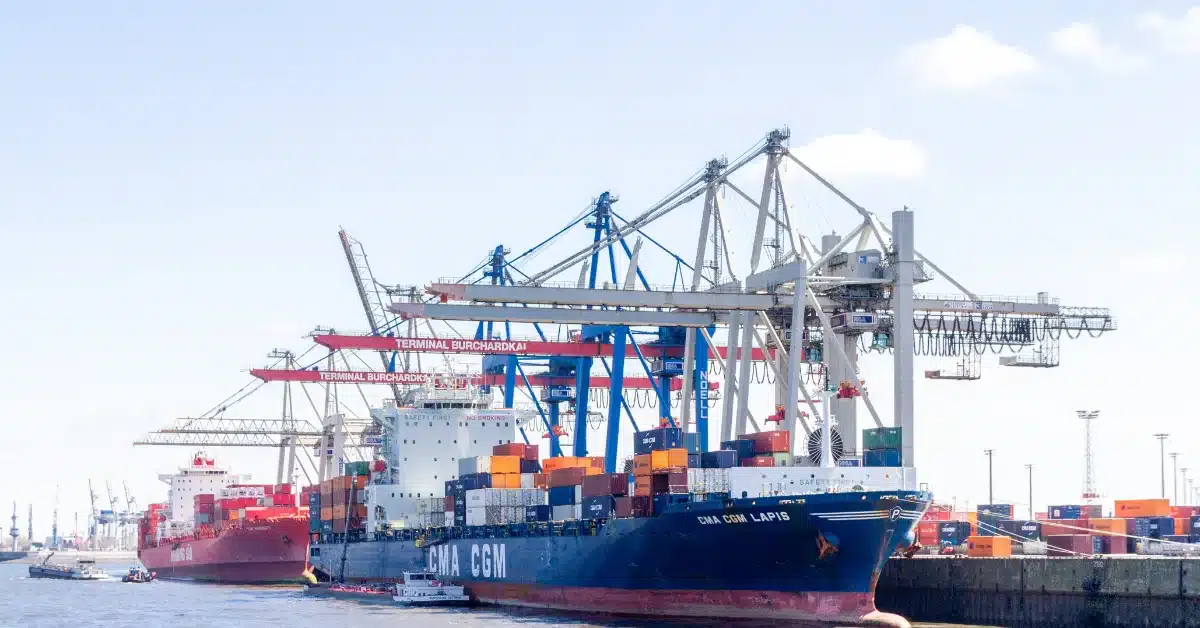

Online and physical auctions move huge volumes of vehicles and equipment across the map.
You win a unit, the clock starts, and storage fees wait at the yard gate.
You need a simple way to move each purchase from auction yard to port, terminal, or final destination without stress, guesswork, or surprise cost.
XRT focuses on a full chain approach. From pickup at the yard through delivery at your location, the work stays under one structured process that fits dealers, fleets, exporters, and project owners.
Market context: why auction buyers rely on transport partners
Car auctions form a large global market. One recent study places market value near 385 billion USD in 2025, with a path toward 580 billion by 2033. Growth tracks near eight percent per year.
Online channels also shift how units move. Research on auto transportation links around 28 percent of new and used car sales to online platforms, which represents more than 26 million vehicles, and shows demand for auto transport up near 19 percent as a result.
Salvage auctions form a second strong stream. The online salvage auction market sits near 10 to 11 billion USD and projections point toward more than 22 billion USD by 2030, with annual growth above 15 percent.
For heavy equipment, auction houses sell bulldozers, excavators, cranes, and trucks to buyers across borders. These moves need lowboys, step decks, and RGN trailers, plus permits and escorts for oversize units.
This growth shifts pressure to transport partners. Buyers need more than a rate per mile. They need a process.
Key needs from auction buyers include:
- Pickup that respects free storage windows.
- Correct carriers for running, non-running, and damaged units.
- Coverage across states and across ports.
- Clear transit plans from yard to final location.
- Communication that supports decision making across multiple purchases.
XRT shapes its approach around these needs.
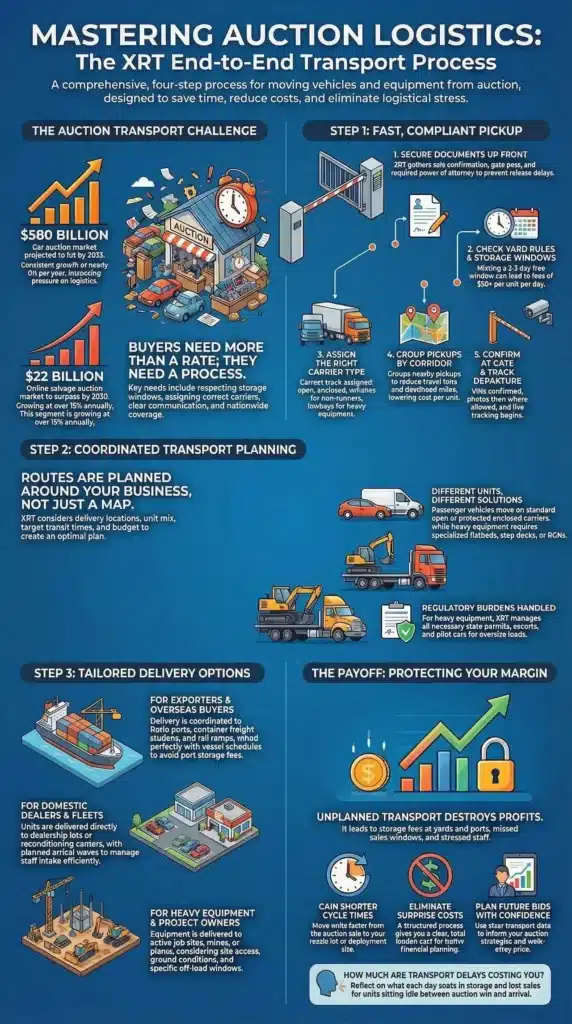
Step 1: fast, compliant pickup from auction yards
Every successful auction transport flow starts with clean pickup.
XRT builds this stage around five actions.
1. Secure documents up front
Yards need the right paperwork before release.
XRT requests from you:
- sale confirmation
- gate pass or pickup authorization
- power of attorney when required
- proof of payment where yards request it
Time lost on missing documents turns into storage fees and re-scheduled trucks.
2. Check yard rules and storage windows
Each auction and yard has its own rules.
Examples:
- Many Copart locations hold vehicles three days including sale day at no cost, then storage fees start per calendar day.
- Some salvage yards only offer two free business days. Storage for five units at 50 USD per day over three days reaches 750 USD.
XRT maintains yard rule notes and places free storage windows on a shared timeline. This timeline guides dispatch decisions.
3. Assign the right carrier type
Not every truck fits every yard or unit.
XRT assigns:
- standard open carriers for regular running vehicles
- enclosed carriers for high value or sensitive units where you request extra protection
- carriers with winches and soft straps for non-running and salvage vehicles
- flatbeds and specialized trailers for equipment
For heavy equipment, XRT checks yard equipment, ramps, and load points. No guesswork on how to move a 30-ton machine onto a lowboy.
4. Group pickups by corridor
Many buyers source units from several auctions in the same region.
XRT groups pickups across nearby yards when possible, within their storage windows, to reduce:
- travel time between yards
- deadhead miles
- extra days on yard
This grouping lowers cost per unit and gives a clear pickup window for each cluster.
5. Confirm at gate and track departure
Before units exit the yard, XRT confirms:
- VIN or serial number
- visible damage
- photo set where allowed
From there, tracking starts and you receive status updates through the agreed channel.
Step 2: transport coordination by buyer location and unit profile
Pickup is only the first stage.
Next, XRT builds the move from yard to destination based on your operation, not only on a straight line on a map.
Key inputs:
- where you receive units
- how you sell or use them
- what mix of vehicles and equipment you handle
- your target transit times and budgets
Vehicle routes and service types
For passenger vehicles and light trucks, XRT plans around open or enclosed transport.
- Open carriers fit most standard auction units.
- Enclosed trailers serve classic, luxury, or rare vehicles, with higher protection and different pricing.
Route planning weighs:
- yard location
- delivery region
- fuel and toll patterns
- likely weather windows over route
Dispatch groups vehicles by corridor where possible, again to lower per-unit cost and keep schedules predictable.
Heavy equipment profiles and trailers
For equipment from auctions such as Ritchie Bros or other industrial platforms, XRT starts with specs:
- length, width, height
- weight and axle loads
- attachment details
- special handling needs
Trailer options include:
- flatbeds for compact loads
- step decks for taller units
- lowboys and RGNs for heavy or oversize equipment
Regulatory work covers:
- oversize permits across each state on the route
- escort and pilot car setup when needed
- travel time restrictions, such as daytime only or weekday only
One example: a crawler excavator leaving a Midwest auction for a job site in the Southwest. With correct axle spacing and permit planning in advance, the move runs on schedule instead of stopping at each state line.
Step 3: delivery options – ports, terminals, yards, and final mile
Different buyers follow different strategies.
XRT does not force one delivery pattern. Instead, the team maps delivery to your business model.
Exporters and overseas buyers
Export buyers often prefer delivery to:
- RoRo ports
- container freight stations
- rail ramps feeding ports
- bonded warehouses
Industry examples show mixed inland and ocean routes from auction to buyers overseas, with inland trucking linked to vessel schedules and port deadlines.
XRT:
- moves units from auction yards to selected ports or terminals
- coordinates with forwarders or NVOCCs for RoRo or container loading
- aligns pickup and delivery with cut-off dates to avoid roll-overs and storage at port
Domestic dealers and fleets
Domestic buyers often direct deliveries to:
- dealership lots
- reconditioning centers
- satellite storage yards
For large groups, XRT plans arrival waves, so staff handle intake and photos over set days instead of random arrivals.
Heavy equipment and project owners
For many projects, equipment needs to reach job sites, mines, or plants, not yards.
XRT plans:
- site access constraints
- ground conditions
- off-load equipment on site
- delivery windows, often early morning or late evening
Clear delivery plans reduce idle time for operators and avoid extra site visits.
Step 4: domestic and international coverage
A true end-to-end solution needs reach.
Domestic coverage
Within the United States, XRT:
- maintains carrier relationships around major auction clusters
- focuses on key corridors from these clusters to dealer regions and ports
- tracks carrier performance through on-time pickup and delivery rates
Special attention goes to corridors that serve Alaska, Hawaii, and U.S. territories, where ocean segments come into play.
International shipping support
For global exports, XRT works alongside freight forwarders, NVOCCs, and port agents.
XRT assists with:
- preparation of titles for export
- coordination of inspections where required
- delivery to consolidation points for containers
- alignment of yard pickup with vessel schedules
The broad trend is clear. Growth in car auctions and salvage auctions worldwide raises demand for structured international shipping of vehicles and equipment.
Speed, accuracy, and yard time reduction
Auction buyers focus on margin per unit and inventory turns. Transport process ties directly into both.
Three metrics matter:
- days from sale to pickup
- days from pickup to arrival
- storage fees along the way
Industry guides on auction transport stress that storage fees start after short free periods and that transport must move on tight timelines.
XRT works with these metrics in mind.
Speed
- yard rules and free storage windows sit on a shared calendar
- dispatch plans pickups inside those windows
- routes group units for efficient runs without long detours
Accuracy
- VINs, serial numbers, and locations stay confirmed at each stage
- drivers receive full paperwork in advance
- status updates reach you at agreed checkpoints
Yard time reduction
- free storage windows remain visible for each unit
- risk units, where free periods end soon, receive priority
- multi-unit buyers receive suggestions for best auction mix by region, based on storage and transport patterns
Question for reflection: how many days do your vehicles and equipment sit between sale and arrival today, and what does each day cost in storage and lost sales?
What buyers should share with XRT before bidding
Strong results start before the auction.
When you share basic plans with XRT ahead of bidding, the team can prepare routes and ranges that keep your total cost within reason.
Share:
- typical auction platforms and regions
- planned mix of vehicles and equipment
- main delivery regions and ports
- target volume per month
- timing rules on your side, such as intake hours and job start dates
With this context, XRT provides:
- sample routes and rate ranges
- lead times for each corridor
- trailer types likely needed for your mix
You enter the auction with a clear view of transport impact on your walk-away price.
FAQ: auction transport with XRT
1. How soon should you arrange transport after an auction win?
Best practice is to schedule transport as soon as your payment clears and gate pass becomes available. Many yards offer only a few free days before storage fees begin.
2. Which documents does XRT need for pickup?
XRT needs sale confirmation, gate pass or pickup authorization, proof of payment where required, and a contact at the yard. For exports, export titles and any needed powers of attorney enter the file as well.
3. How does XRT handle non-running or damaged units?
XRT assigns carriers with winches, soft straps, and experience at salvage yards. Dispatch notes unit condition so drivers arrive prepared, which protects equipment and reduces yard delays.
4. Does XRT support heavy equipment from auctions?
Yes. XRT supports bulldozers, excavators, cranes, trucks, and other machinery from auctions, with lowboy, step deck, and RGN options plus permit support.
5. What delivery options exist for exporters?
Exporters receive delivery to RoRo ports, container freight stations, rail ramps that serve ports, and bonded warehouses, with timelines tied to vessel schedules and cut-offs.
6. How does XRT help reduce storage fees and yard time?
XRT tracks free storage periods, prioritizes at-risk units, groups pickups by corridor, and moves units with clear dates from yard to port or final destination.
7. What insurance and licensing standards apply?
XRT works with carriers that hold active FMCSA authority, proper cargo insurance, and clean safety records, which you can verify in the FMCSA Company Snapshot database.
Closing section: why structured auction transport protects margin
Auction wins only turn into profit when units reach your lot, job site, or buyer on time and at a known total cost.
Unplanned transport leads to:
- storage fees at auction yards
- extra storage at ports and terminals
- missed sales windows
- stressed staff and rushed handoffs
A structured, end-to-end transport process removes these points of failure.
XRT aligns documents, pickup, route planning, delivery mode selection, and tracking under one workflow built for auction buyers of vehicles and equipment.
You gain:
- fewer surprises in total landed cost
- shorter cycle time from sale to resale or deployment
- clearer data to plan future auction strategies
With the right transport partner, auction sourcing turns from a logistics burden into a repeatable part of your supply strategy.